
Nonfiction
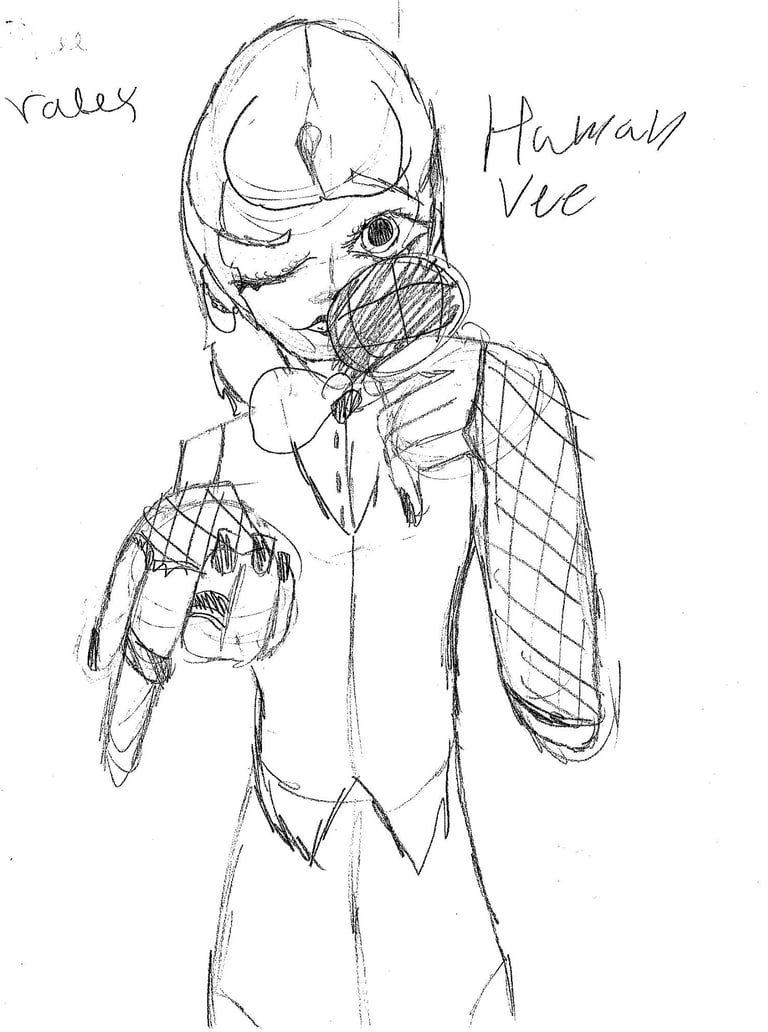
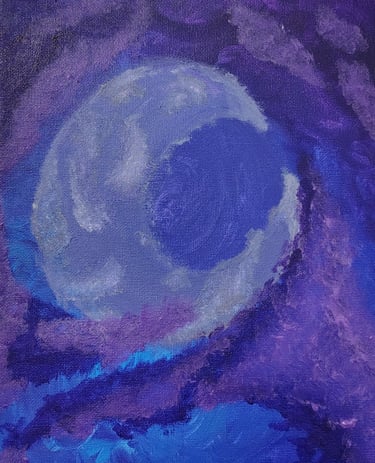
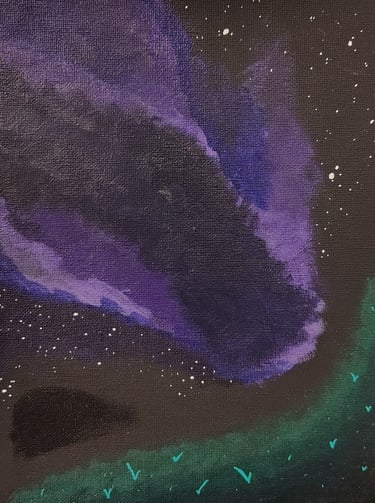
Black & White Sketch by Emma Peters
Paintings
by
Hayden Zink
Dawn of a New Era:
The Chicxulub Impact
by Margaret Hayton
Sixty six million years ago, dinosaurs roamed the Earth– populations booming, lands thriving, things certainly seemed to be looking up for the ancient reptiles; that was, until the Chicxulub asteroid hit. No animal was spared suffering– whether it be the impact itself, the great tsunamis it brought, the acid rain it wrought, or the minor ice age it caused. Picture this: you’re an Ankylosaurus, possibly grazing whilst looking up at the night sky. You may have noticed a new star. Only, this wasn’t like any other star you had seen before; in fact, it wasn’t a star at all. Rather, a carbonaceous asteroid larger than Mount Everest; barrelling toward the Yucatan Peninsula in Mexico at an astounding 40,000 miles per hour. Within 48 hours of this new ‘star’ appearing in the night sky, it would hit–causing mass destruction and death– and ultimately ending the reign of the dinosaurs forever. Given such circumstances, it’s likely you’ll wonder how, or why. Luckily, technology has come a long way since the Cretaceous era; so first, let’s talk about the asteroid itself.
The Chicxulub impact and crater was caused by a large, 110 mile long asteroid that hit the coast of the Yucatan Peninsula in Mexico. At first, scientists believed it to be a typical comet; only larger. However, after more extensive research, it was revealed to be a rare carbonaceous asteroid rather than the usual type. The asteroid originated in an ancient asteroid belt beyond Jupiter, the largest planet in the solar system; and likely circled the planet for thousands, if not millions of years before the impact. Given its size, it broke through the atmosphere at an astounding 40,000 miles per hour, allowing it to hit the face of the Earth within 48 hours of it being visible in the sky. It appeared as a new star at first, plowing its way through the atmosphere; slowly growing in size until it became the size of the moon and slowly disappeared as it descended into Earth’s shadow. Little did the dinosaurs know upon seeing this new ‘star’, it would cause one of the largest doomsday events in Earth’s history– and there was nothing they could do to escape it. Speaking of the dinosaurs, let’s talk about the animals inhabiting Earth and how they were impacted.
Dinosaurs included the largest land animals of all time– and lived on the Earth’s surface for more than 150 million years; although this was not to last. Due to the asteroid’s impact, every single non-aviary dinosaur perished– causing one of the greatest extinction events in history. Furthermore, the extinction winterkilled 80% of all animals on Earth. Groups that went extinct include but are not limited to the ammonoid cephalopods, which were relatives of modern-day squids and octopi, pterosaurs, and non-aviary dinosaurs. However, smaller aviary dinosaurs survived; evolving into the modern birds we have today. Dinosaurs that share similarities with modern-day birds are suggested to have lived the longest according to fossil evidence, though amphibians also outlived many other animals of the time. Furthermore, the land surface was crowded with many new placental mammals which quickly diversified during the Paleogene era; and even despite the mass destruction, some animals including sharks and multiple types of insects remained unscathed. Fortunately, many of the deaths occurred immediately– however, it took the Earth a bit more time to recover.
Although the asteroid’s impact itself was devastating, the impact it left on the Earth for millions of years afterwards was arguably worse. The Chicxulub impact caused the sudden eruption of volcanoes around the world due to the massive crater it left; shifting tectonic plates. Additionally, the ash released in the explosions was incredibly poisonous for animals to breathe. The strike also sent dust and other less solid debris into the air, covering Earth entirely, blocking the Sun (therefore reaching dangerously cold temperatures and even a minor ice age), and poisoning the air even further. Furthermore, the sudden shift in tectonic plates that caused the sudden eruption of volcanoes also caused tsunamis of incredible magnitude and height; bigger than any human has ever seen. After the dust and toxic ash was released into the atmosphere, it condensed into clouds and regularly rained acid. Although many animals died to the asteroid on impact, most actually went extinct because of the effects it had on the Earth afterwards–and it took millions of years for Earth to return to normal.
It’s important to learn about the history of our Earth to achieve a better understanding of Earth itself– and to ensure something like this doesn’t happen again. Since researching this topic, technology has come a long way; therefore equipping us with the necessary knowledge and understanding the next time an asteroid comes rolling around in order to stop it. It’s also important to learn about the animals that once inhabited this Earth and how the asteroid impacted them because without the dinosaurs paired with the mass extinction event, humans would cease to exist. In summary, learning about the history of the asteroid and Earth ensures learning about the journey of the human species throughout history; and prevents history from repeating itself.
Ferreira, Becky. “Rare Backstory for Dinosaur-Killing Asteroid.” New York Times, vol. 173, no. 60259, Aug. 2024, p. D4. EBSCOhost, research.ebsco.com/linkprocessor/plink?id=36147296-9e4a-3585-9254-e6c93ff28dee
Gramling, Carolyn. “Dinosaur Killer’s Origin Revealed.” Science News, vol. 206, no. 4, Sept. 2024, p. 7. EBSCOhost, research.ebsco.com/linkprocessor/plink?id=67ccb105-1c24-3b20-92e4-7bb66dcb5baf
Gallivan, Peter. “HEADSCRATCHERS.” Week Junior: Science + Nature, no. 72, Mar. 2024, pp. 22–23. EBSCOhost, research.ebsco.com/linkprocessor/plink?id=648af84a-7d3c-3875-a40e-892da913f27f
Lucas, Spencer G. “Cretaceous-Paleogene Boundary.” Salem Press Encyclopedia of Science, July 2024. EBSCOhost, research.ebsco.com/linkprocessor/plink?id=990b1deb-7a93-3402-b85f-ae95c16df217
Preston, Elizabeth. “When the Dinosaurs Died.” Muse (1090-0381), vol. 26, no. 6, July 2022, p. 6. EBSCOhost, research.ebsco.com/linkprocessor/plink?id=1be8647c-c46e-3112-9235-aa9660f3eca2